


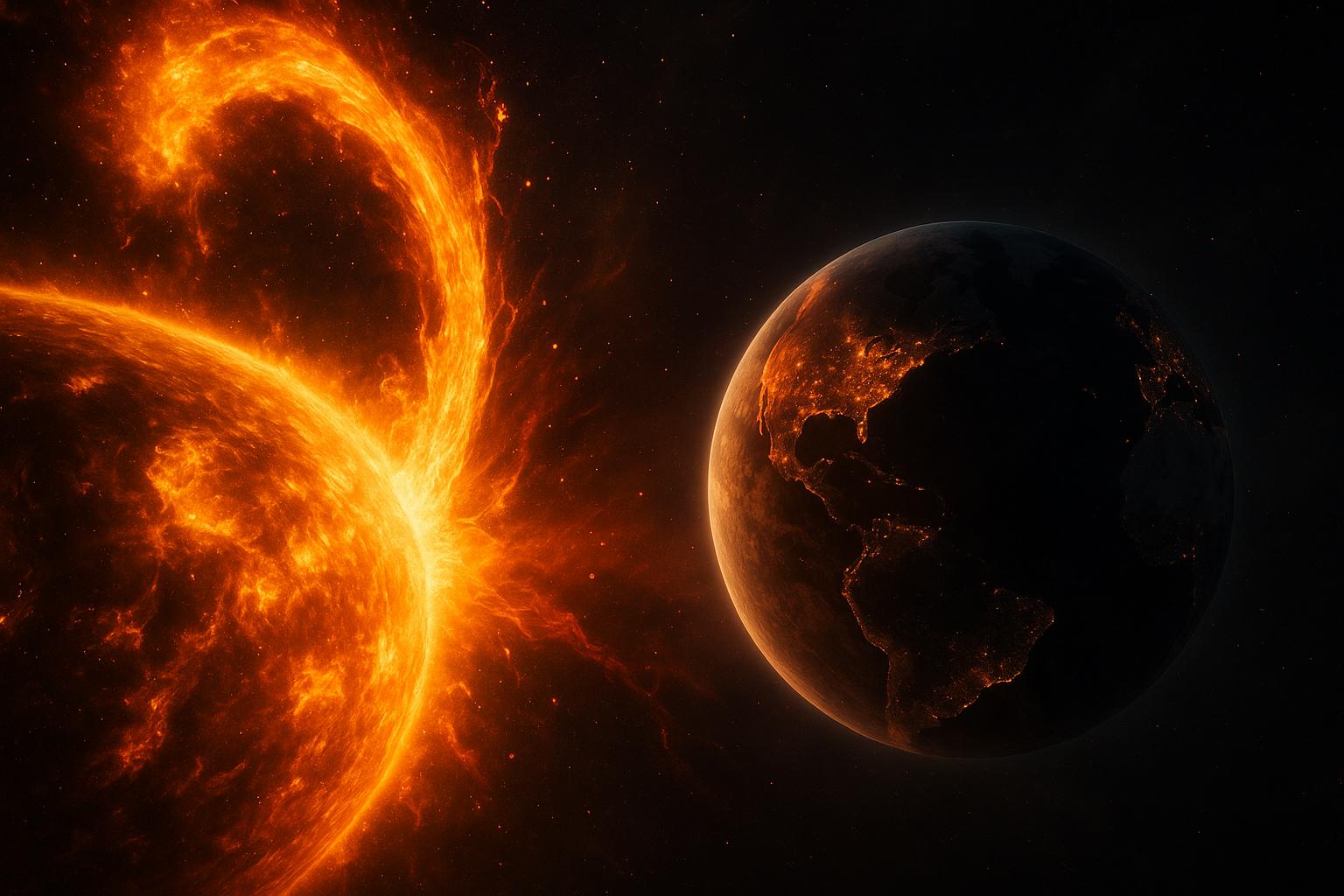
Recent local power surges and a massive solar flare highlight society’s fragile dependence on digital infrastructure, raising fears of catastrophic disruptions akin to the historic Carrington Event that could cripple modern life.
An explosion resembling a bomb rocked windows and plunged a Bristol neighbourhood into darkness during a thunderstorm, with lightning striking and damaging a TV aerial. More significantly, an electrical surge fried internet modems and routers in over a dozen homes, leaving one family without internet for four days. This real-life disruption underscores just how dependent modern society is on electronic data transmission, relying on the internet not only for communication but also for everyday comforts like heating and music systems. Shortly after this local blackout, a global outage struck Amazon’s cloud services, affecting banking platforms such as Lloyds and Halifax, social media apps like Snapchat and Reddit, and even Amazon’s own smart devices such as Alexa and Ring doorbells. These incidents highlight the fragility of digital infrastructure in the 21st century.
Beyond personal inconvenience, the economic impact of disruptions to digital infrastructure can be severe. Last year, British companies Marks & Spencer and Jaguar Land Rover suffered major ransomware attacks that crippled their online operations and supply chains. M&S experienced blocked online sales for weeks, costing around £300 million, while Jaguar Land Rover’s five-week shutdown of production lines inflicted an estimated £1.9 billion loss on the British economy. The car manufacturer recently reported that profits turned into a significant loss, including £196 million in cyber-related costs, underscoring the vulnerability of critical industries to cyber threats.
However, a catastrophic global outage might not solely stem from cyberattacks. Experts warn that a natural event, specifically a massive solar flare and its associated coronal mass ejection (CME), could trigger a more devastating scenario. On a recent Tuesday, the Sun emitted a powerful X5.1-class solar flare, the largest in over a year, which propelled a CME toward Earth at 3,000 miles per second. Solar flares are categorised from A to X, with X representing the most powerful, and fractional increments indicate increasing intensity. This flare caused radio blackouts in Europe and Africa and was accompanied by what scientists call a ground-level enhancement, where solar particles reached the Earth’s surface , a rare occurrence.

Historical precedent for such events comes from the Carrington Event of 1859, which caused telegraph systems across Europe and North America to fail, sparking fires and electrical shocks. If a similar or more powerful event were to occur today, the impact could be catastrophic given society’s dependence on electricity and digital technology.
Scientists and cybersecurity experts imagine a worst-case scenario unfolding rapidly in the event of an extreme solar storm. Within moments, satellites would be knocked out, crippling mobile phone, GPS, and military communication systems. The International Space Station’s circuits could fail catastrophically, with tragic consequences for its occupants. On Earth, electrical surges would fry appliances and devices, power grids like the National Grid would fail, and traffic systems would collapse, leading to widespread accidents. Emergency services would be overwhelmed or rendered inoperable due to communication failures. Fires would rage unchecked as firefighting coordination collapses, while aviation would face mid-air collisions caused by non-functional instruments.
Initial geopolitical fallout might include Russia and China leveraging their national intranets to maintain limited communications and portraying Western failure as societal collapse. Meanwhile in Britain, the military and police would have to impose order amid looting and chaos, with essential services like hospitals struggling to function under backup power only, cancelling surgeries, and managing burn and smoke inhalation injuries. Key infrastructure such as supply chains, fuel deliveries, and water distribution would falter or fail, pushing society into an almost medieval state. Those accustomed to pre-internet life would adapt better, whereas younger generations, heavily reliant on social media and digital interfaces, would be particularly disoriented and distressed.
Longer term, attempts to restore internet service would be complicated by the loss of cloud data centres and critical infrastructure, with governments vulnerable to cyberattacks from criminals and hostile states exploiting the situation to further their aims. Food shortages, power outages, outbreaks of disease, and mass casualties could create a national emergency of unprecedented scale, driven initially by a single natural disaster impacting an electronic network as fragile as a cobweb.
This scenario is underscored by ongoing solar activity. The National Oceanic and Atmospheric Administration (NOAA) and space weather experts have issued geomagnetic storm watches due to continuing solar flare activity associated with the sun’s 11-year magnetic cycle, now approaching its peak expected around 2025. Satellite communication and navigation systems face periodic disruptions; Starlink, a major satellite internet provider, has already reported degraded service amidst the most significant geomagnetic storm in two decades. Yet, despite these warnings and minor interruptions, the overall risk to the general public remains low at present.
However, experts caution that a larger-scale event remains a possibility. The economic and societal costs of a storm comparable to the historic Carrington Event could reach nearly $2 trillion in the U.S. alone, potentially leaving 20 to 40 million people without power for weeks or even years and crippling critical infrastructure including telecommunications, banking, and energy grids. With society’s deepening digital dependencies, the need for robust warning systems and resilient infrastructure to mitigate the impact of extreme space weather is increasingly urgent.
In light of recent localized outages and global solar activity, the question remains: how prepared are nations to face a scenario where the delicate digital web underpinning modern life is severed by forces beyond human control?
📌 Reference Map:
- [1] Daily Mail – Paragraphs 1-18, 20-27
- [2] AP News – Paragraph 19
- [3] AP News – Paragraph 19
- [4] Reuters – Paragraph 19
- [5] Reuters – Paragraph 19
- [6] NOAA NESDIS – Paragraph 19
- [7] AP News – Paragraph 19
Source: Noah Wire Services
Noah Fact Check Pro
The draft above was created using the information available at the time the story first
emerged. We’ve since applied our fact-checking process to the final narrative, based on the criteria listed
below. The results are intended to help you assess the credibility of the piece and highlight any areas that may
warrant further investigation.
Freshness check
Score:
7
Notes:
The narrative presents a recent event involving a Bristol neighbourhood blackout during a thunderstorm, leading to internet outages. This incident is used to segue into a discussion about the potential impacts of a massive solar flare on modern infrastructure. The article references a recent X5.1-class solar flare, the largest in over a year, which occurred on a recent Tuesday. However, the exact date of this event is not specified, making it challenging to assess the freshness of the content. The article also includes historical context, such as the Carrington Event of 1859, which is well-documented. The inclusion of updated data about the recent solar flare may justify a higher freshness score, but the lack of specific dates and the recycling of older material warrant a flag. Additionally, the article includes references to other sources, such as AP News and Reuters, indicating that some content may have been republished across multiple outlets. This raises concerns about the originality of the narrative. The presence of a press release may also contribute to the recycled nature of the content. Overall, the freshness score is moderate due to the mix of recent and recycled information.
Quotes check
Score:
6
Notes:
The article includes direct quotes from experts and historical accounts. However, without specific citations or dates, it’s difficult to verify the originality of these quotes. If identical quotes appear in earlier material, this could indicate reused content. The lack of verifiable sources for these quotes raises concerns about their authenticity. The absence of online matches for some quotes suggests they may be original or exclusive content, but this cannot be confirmed without further information.
Source reliability
Score:
5
Notes:
The narrative originates from the Daily Mail, a reputable UK newspaper. However, the article includes references to other sources, such as AP News and Reuters, which may have been republished across multiple outlets. This raises concerns about the originality and reliability of the content. The presence of a press release may also contribute to the recycled nature of the content. Overall, the source reliability score is moderate due to the mix of reputable and potentially recycled information.
Plausability check
Score:
8
Notes:
The article discusses the potential impacts of a massive solar flare on modern infrastructure, referencing historical events like the Carrington Event of 1859 and the recent X5.1-class solar flare. The claims about the potential economic impact of a solar storm are supported by studies estimating damages between $0.6 and $2.6 trillion in the U.S. alone. The narrative also aligns with scientific understanding of solar storms and their potential effects on electrical grids and communication systems. However, the lack of specific dates and verifiable sources for some claims raises questions about the accuracy of certain details. Overall, the plausibility score is high, but the absence of specific citations and dates warrants caution.
Overall assessment
Verdict (FAIL, OPEN, PASS): OPEN
Confidence (LOW, MEDIUM, HIGH): MEDIUM
Summary:
The narrative presents a mix of recent and recycled information, with references to historical events and recent solar flare activity. The inclusion of updated data about the recent solar flare may justify a higher freshness score, but the lack of specific dates and the recycling of older material warrant a flag. The presence of a press release may also contribute to the recycled nature of the content. The source reliability score is moderate due to the mix of reputable and potentially recycled information. The plausibility score is high, but the absence of specific citations and dates raises questions about the accuracy of certain details. Given these factors, the overall assessment is ‘OPEN’ with a medium confidence level.

