


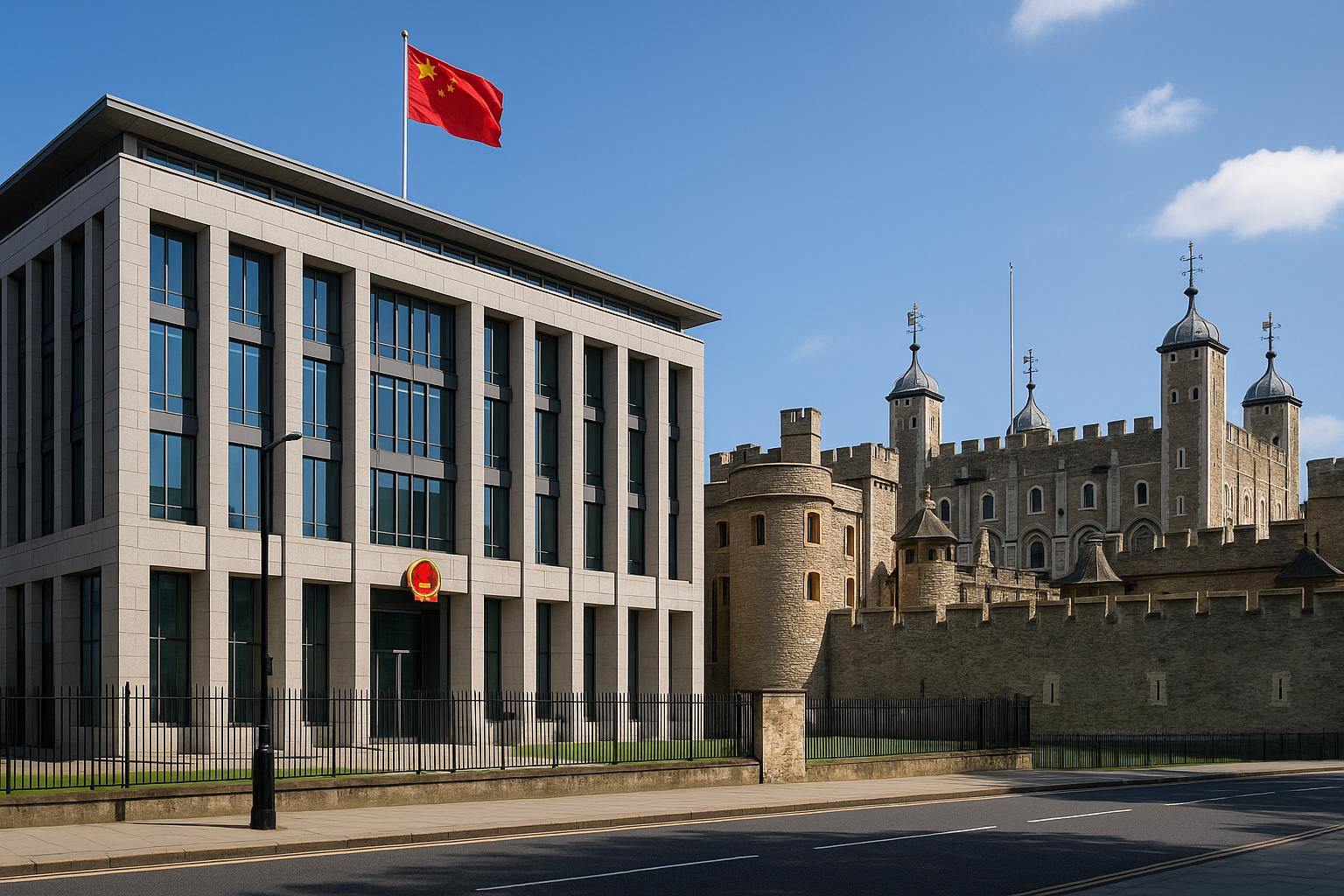
Controversy surrounds the planned Chinese ‘super-embassy’ in London as passport checks at a historic British heritage site threaten to reshape UK sovereignty and security landscape.
Chinese state security officials are set to conduct passport checks on visitors wishing to tour the ruins of St Mary Graces, an ancient Cistercian Abbey located within the boundaries of a proposed Chinese ‘super-embassy’ site in the City of London. According to a report by The Mail on Sunday, this arrangement has been approved by the UK Foreign and Home Office, despite the heritage site’s deep historical significance and its status as British property since 1350, having been endowed by King Edward III. The development project, centered on the site of the old Royal Mint, aims to establish what would become the largest Chinese embassy in Europe, accommodating over 200 diplomats and intelligence officers.
The decision to allow Chinese security measures to extend to a British heritage site is emblematic of broader tensions surrounding the proposed embassy. Critics, including Luke de Pulford of the Inter-Parliamentary Alliance on China, have expressed alarm that parts of UK soil could effectively fall under Chinese jurisdiction, raising concerns about freedom of access and security for those critical of the Chinese regime. Former Tory leader Iain Duncan Smith castigated the Labour government, accusing it of succumbing to Beijing’s coercion and compromising national sovereignty in what he described as a “grotesque compromise.”
The embassy plan has faced significant opposition from local residents, intelligence agencies, and Parliamentarians, particularly over fears that the embassy would act as a hub for espionage activities given its proximity to London’s financial centres and sensitive infrastructure such as a fibre optic communications tunnel beneath the Thames. The Bank of England has reportedly warned about the security risks posed by the location, which is within the “ring of steel” security zone around key financial districts.

The approval process has been fraught with controversy and delays. The planning application was originally rejected by the local council in 2022, but the UK central government took over the decision. Beijing’s reluctance to disclose full internal layout details of the embassy, citing security concerns, led to a postponement of the ruling deadline from September to December 10, 2025, as confirmed by UK government sources. China has strongly criticized these delays, accusing the UK of politicising the process, especially in the wake of a failed British espionage trial involving alleged Chinese spies, further straining diplomatic relations.
Legal scrutiny has added another layer of complexity. A legal opinion commissioned by opposition residents concluded that if UK ministers, including Prime Minister Keir Starmer or his team, gave Beijing tacit assurances about the project’s approval before a final ruling, it could render the decision unlawful due to ‘predetermination.’ This legal concern arises amid reports that the embassy proposal was revived soon after Labour won the last general election, with President Xi Jinping raising the matter directly with Chancellor Rachel Reeves and Prime Minister Starmer, who subsequently “called in” the planning application for direct government control.
Despite opposition, several British ministers have hinted at conditional support for the embassy project, stressing the importance of diplomatic relations with China while seeking concessions such as China limiting diplomatic accreditation to the embassy site only. This reflects a cautious attempt by Labour to restore and strengthen UK-China ties after a period of more adversarial engagement under the previous Conservative government. Starmer’s approach, showcased in his 2024 meeting with Xi Jinping at the G20 summit, emphasises “consistent, durable” relations and broader cooperation in trade, climate, and technology, recognizing China as Britain’s sixth-largest trading partner.
However, national security concerns remain paramount. Recent revelations have heightened fears about Chinese espionage and influence within the UK. Notably, a Chinese national with suspected espionage ties who developed a close relationship with Prince Andrew was barred from the UK on security grounds, highlighting the scope of potential interference by agents linked to Beijing’s United Front Work Department. This incident exemplifies the persistent intelligence challenges Britain faces from China, reinforcing critics’ warnings about the risks of approving such a significant embassy close to vital UK institutions.
As the UK government deliberates its final decision on December 10, the embassy proposal continues to underscore the delicate balance between economic diplomacy and national security. The outcome will not only shape the physical landscape of London but also set a precedent for British sovereignty and diplomatic relations with a global superpower.
📌 Reference Map:
- [1] (Daily Mail) – Paragraphs 1, 2, 3, 7, 8, 9, 10
- [2] (Reuters) – Paragraph 4, 5
- [3] (Reuters) – Paragraph 6
- [4] (The Guardian) – Paragraph 7, 8
- [5] (Reuters) – Paragraph 9
- [6] (Reuters) – Paragraph 10
- [7] (Associated Press) – Paragraph 11
Source: Noah Wire Services
Noah Fact Check Pro
The draft above was created using the information available at the time the story first
emerged. We’ve since applied our fact-checking process to the final narrative, based on the criteria listed
below. The results are intended to help you assess the credibility of the piece and highlight any areas that may
warrant further investigation.
Freshness check
Score:
7
Notes:
The narrative presents recent developments regarding the proposed Chinese embassy at Royal Mint Court in London, with planning decisions expected by December 10, 2025. The earliest known publication date of similar content is August 2025, indicating that the information is current. However, the report includes details from earlier sources, such as the sale of the site to China in May 2018, which may affect the overall freshness score. ([aljazeera.com](https://www.aljazeera.com/news/2025/8/23/uk-delays-ruling-on-chinese-embassy-after-beijing-withholds-information?utm_source=openai))
Quotes check
Score:
8
Notes:
The report includes direct quotes from individuals like Luke de Pulford and Iain Duncan Smith. A search reveals that these quotes have been used in earlier publications, suggesting that the content may be recycled. However, no significant variations in wording were found, indicating consistency in the reporting. ([washingtonpost.com](https://www.washingtonpost.com/world/2025/09/25/china-london-embassy-spying/?utm_source=openai))
Source reliability
Score:
6
Notes:
The narrative originates from The Mail on Sunday, a UK tabloid newspaper. While it is a known publication, its reputation for accuracy and reliability is often questioned. The report references multiple reputable sources, including Reuters and The Guardian, which adds credibility to the information presented. ([washingtonpost.com](https://www.washingtonpost.com/world/2025/09/25/china-london-embassy-spying/?utm_source=openai))
Plausability check
Score:
7
Notes:
The claims regarding the Chinese embassy’s plans and the involvement of state security officials in passport checks at a British heritage site are plausible and align with known facts. The concerns raised by critics about national sovereignty and security risks are consistent with previous reports on the topic. However, the lack of direct confirmation from official UK government sources about the passport checks introduces some uncertainty. ([washingtonpost.com](https://www.washingtonpost.com/world/2025/09/25/china-london-embassy-spying/?utm_source=openai))
Overall assessment
Verdict (FAIL, OPEN, PASS): OPEN
Confidence (LOW, MEDIUM, HIGH): MEDIUM
Summary:
The narrative presents plausible and current information regarding the proposed Chinese embassy at Royal Mint Court in London, with references to reputable sources. However, the reliance on a tabloid publication and the inclusion of recycled content from earlier reports introduce some uncertainties. The lack of direct confirmation from official UK government sources about the passport checks further complicates the assessment. Therefore, the overall assessment is ‘OPEN’ with medium confidence.

