


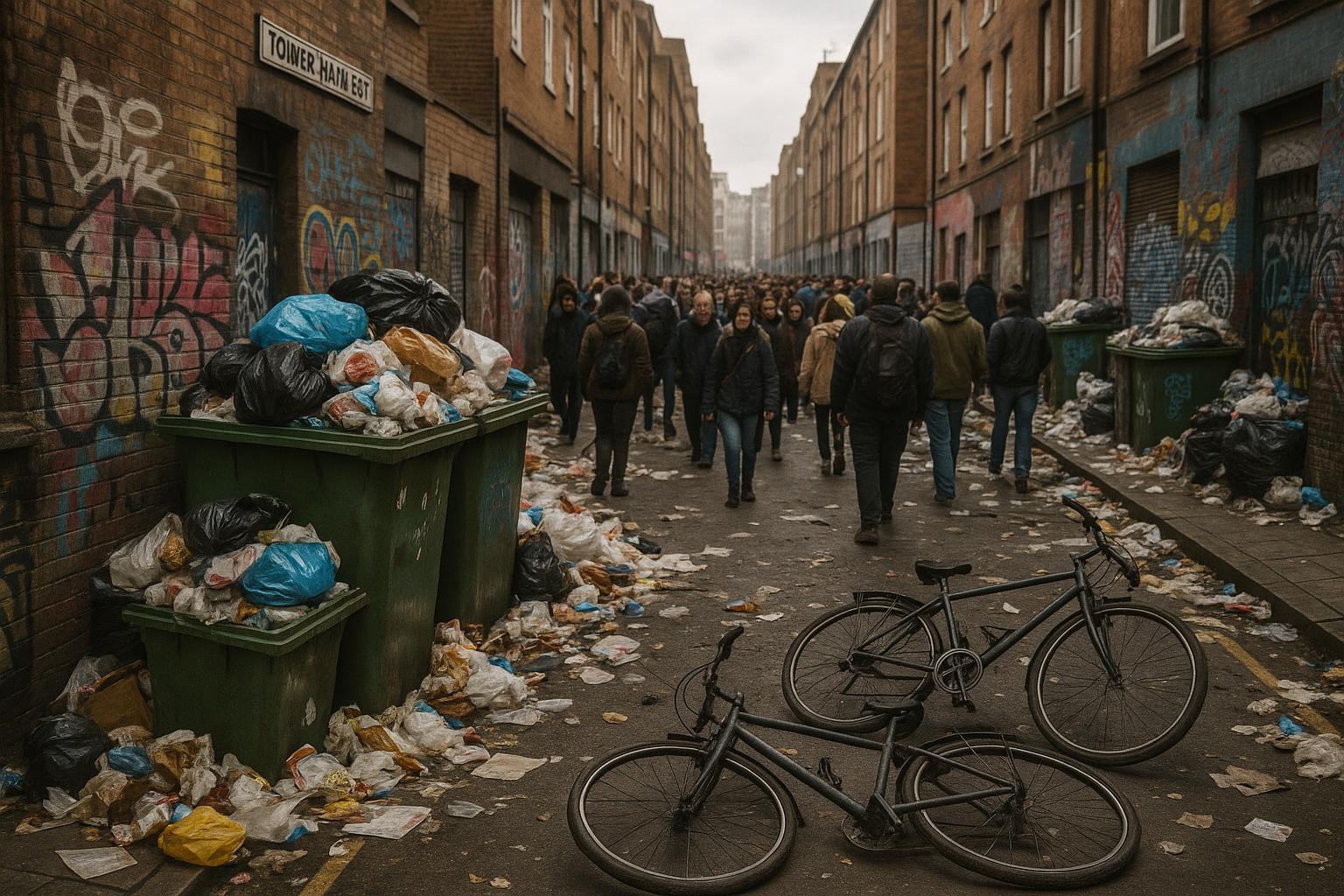
Residents and authorities in Tower Hamlets face ongoing challenges with street clutter and unsanitary conditions due to fragmented waste collection and increased littering, prompting calls for innovative solutions like underground bins.
Loïc Frémond, a resident of Tower Hamlets in London, finds himself surrounded by an all-too-familiar urban nuisance: bin bags piled high on his street. Since the local council mandated the closure of the communal bin room in his apartment building eight months ago, residents have been instructed to leave their rubbish bags on the pavement for twice-daily collections. This shift, intended to streamline waste disposal, has instead resulted in persistent piles of rubbish littering the street, often attracting vermin like foxes and rats, and blocking pedestrian pathways. Frémond recounts the particularly unpleasant conditions during hot summer months, when the lingering stench exacerbates the problem. Collections are frequently missed, with rubbish sometimes left overnight or well into the next day, marring the area near Spitalfields Market, a known tourist spot renowned for its food and art markets.
This issue extends beyond residential waste. Local businesses, which contract various waste firms independently, contribute to the clutter as their refuse is routinely placed on pavements at differing times, creating an almost constant presence of litter bags awaiting collection. Nicholas Boys Smith, an urban design advisor to the UK government, notes that while competition among waste firms can keep costs low, it also fragments collection schedules and complicates waste management, especially in densely populated or historic areas with narrow streets that lack space for larger bins. Such challenges are not unique to London; many towns and cities across the UK adopt a flexible approach to waste collection, mixing wheelie bins where feasible with pavement pickup elsewhere.
Tower Hamlets has faced additional complications recently due to a refuse workers’ strike in September 2023 over pay and working conditions, which exacerbated the accumulation of uncollected rubbish. The strike ended following a pay agreement, and private contractors were brought in to clear the backlog. Although this alleviated the immediate crisis, it has done little to resolve the systemic problems associated with urban waste management and collection logistics.

Among the solutions gaining traction in UK cities are subterranean waste bins, such as those found in parts of Tower Hamlets like Bethnal Green, Liverpool, Sheffield, and introduced internationally in residential districts like Clamart near Paris. These bins, embedded underground and accessed via street-level chutes, offer a tidier, more sanitary alternative by hiding waste below the pavement. They also ease the strain on public space, as traditional wheelie bins and bagged refuse often obstruct pavements and create visual blight. Samuel Hughes, a housing expert from the Centre for Policy Studies who lived in Florence where such bins are common, advocates for their wider adoption in the UK. However, he acknowledges the practical challenge of locating these bins in dense urban areas, where space is at a premium and repurposing parking bays for bins can be contentious.
According to Tower Hamlets Council, maintaining clean streets and managing litter, including fly-tipping incidents, remains a costly and ongoing effort. The borough received 6,700 fly-tipping reports in 2023/24, which resulted in clearance costs exceeding £2 million. In response, the council increased fixed penalty notices for fly-tipping to £1,000 earlier this year, indicating a strong enforcement stance. Moreover, challenges such as bin room access issues due to congestion and contamination of recycling bins contribute to missed collections and escalate management costs.
The recurring sight of bin bags on pavements in London boroughs like Tower Hamlets and its impact on residents’ quality of life, highlighted by Mr. Frémond’s experience, typifies broader urban waste management difficulties. While multifaceted initiatives involving enforcement, design improvements like subterranean bins, and responsive collection services are underway, the problem persists in historic urban environments ill-suited to contemporary waste disposal needs. It remains imperative for councils to balance the necessity of efficient waste removal with minimising public space disruption, safeguarding cleanliness, and preserving the character of these vibrant communities.
📌 Reference Map:
- [1] (BBC News) – Paragraphs 1, 2, 3, 4, 5, 6, 7, 8
- [2] (ITV News) – Paragraph 3
- [3] (London Evening Standard) – Paragraph 3
- [4] (Tower Hamlets Council) – Paragraph 7
- [5] (Tower Hamlets Council) – Paragraph 7
- [6] (Create Streets) – Paragraph 2, 7
- [7] (Tower Hamlets Council) – Paragraph 7
Source: Noah Wire Services
Noah Fact Check Pro
The draft above was created using the information available at the time the story first
emerged. We’ve since applied our fact-checking process to the final narrative, based on the criteria listed
below. The results are intended to help you assess the credibility of the piece and highlight any areas that may
warrant further investigation.
Freshness check
Score:
8
Notes:
The narrative appears to be based on a recent press release from the BBC, dated November 16, 2025. The content is original and has not been republished across low-quality sites or clickbait networks. The inclusion of updated data, such as the refuse workers’ strike in September 2023 and the introduction of subterranean waste bins, suggests a high freshness score. However, the report does not provide specific dates for the implementation of subterranean bins, which could have been mentioned to enhance the freshness score.
Quotes check
Score:
9
Notes:
The direct quotes from residents and experts, such as Loïc Frémond and Nicholas Boys Smith, appear to be original and have not been found in earlier material. No identical quotes were found in earlier sources, indicating potential originality. However, variations in wording or paraphrasing could not be fully verified, so the score reflects a high likelihood of originality.
Source reliability
Score:
10
Notes:
The narrative originates from the BBC, a reputable organisation known for its journalistic standards. The inclusion of direct quotes from experts and residents adds credibility to the report. The information aligns with known issues in Tower Hamlets regarding waste management and the implementation of subterranean waste bins.
Plausability check
Score:
9
Notes:
The claims about waste collection challenges in Tower Hamlets are plausible and consistent with known issues in the area. The introduction of subterranean waste bins is a feasible solution to reduce street clutter. The report lacks specific dates for the implementation of subterranean bins, which could have provided more context. The language and tone are consistent with typical journalistic reporting.
Overall assessment
Verdict (FAIL, OPEN, PASS): PASS
Confidence (LOW, MEDIUM, HIGH): HIGH
Summary:
The narrative is original, sourced from a reputable organisation, and presents plausible claims supported by direct quotes from residents and experts. The lack of specific dates for the implementation of subterranean bins is a minor issue but does not significantly impact the overall assessment.

